CHRISTLETON
Curios and Curioser

BY PHILIP HARLAND
Two Little Gouaches
And the Rise of Everyday Art
Whilst rooting through one of my boxes of collected ephemera (aka ‘junk’) the other day I came across a pair of small, framed pictures that I had completely forgotten about. They were part of a Job Lot years ago, unremarkable at first glance and probably thought to be Victorian coloured prints. It was only when I took one out of its simple, gilt wooden frame that I began to suspect otherwise. The surface wasn’t flat and mechanical like a print; it had a faint texture, with tiny ridges where the brush had dragged. There were no printed dots or lines, just brushstrokes. These were not prints at all but original paintings in gouache, the opaque cousin of watercolour. Better still, they turned out to be lovely examples of early 19th-century ‘genre’ painting, scenes of everyday life, full of incident and quiet humour, painted not for a palace or a cathedral but for an ordinary home.
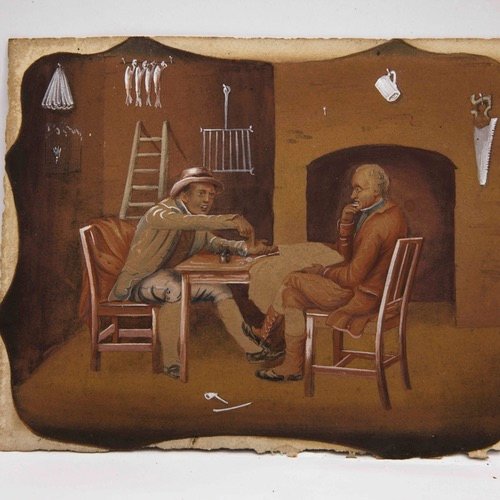
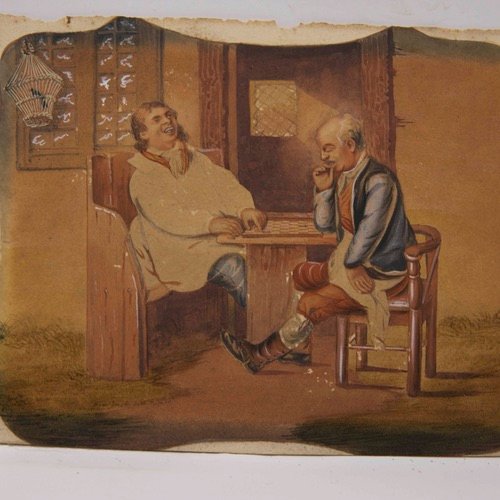
Whilst rooting through one of my boxes of collected ephemera (aka ‘junk’) the other day I came across a pair of small, framed pictures that I had completely forgotten about. They were part of a Job Lot years ago, unremarkable at first glance and probably thought to be Victorian coloured prints. It was only when I took one out of its simple, gilt wooden frame that I began to suspect otherwise. The surface wasn’t flat and mechanical like a print; it had a faint texture, with tiny ridges where the brush had dragged. There were no printed dots or lines, just brushstrokes. These were not prints at all but original paintings in gouache, the opaque cousin of watercolour. Better still, they turned out to be lovely examples of early 19th-century ‘genre’ painting, scenes of everyday life, full of incident and quiet humour, painted not for a palace or a cathedral but for an ordinary home.
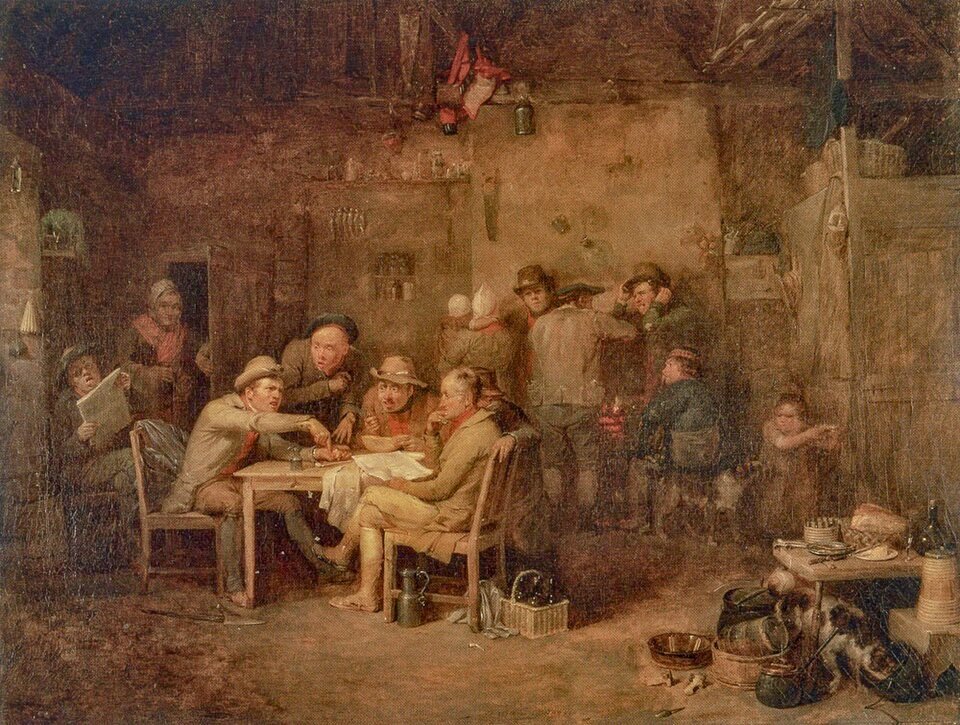
Wilkie's The Village Politicians (1806), the model for much early 19th-century genre art
This was no accident. For centuries, the most prestigious art had been ‘high’ art: grand religious, historical and mythological subjects, commissioned by the Church, the court and the aristocracy, and hung in palaces and great houses. The 19th century changed all that. The Industrial Revolution created a new and growing middle class of merchants, manufacturers, professionals and shopkeepers, who had money to spend and homes to fill (no wonder Victorian living rooms became so cluttered!) but little interest in vast canvases of classical heroes. They wanted pictures they could understand, enjoy and afford: portraits, landscapes, domestic scenes, and gentle stories drawn from the world they knew. Artists and print publishers were quick to respond, and genre painting, small in scale but full of anecdote, became hugely popular. A famous example is David Wilkie’s The Village Politicians of 1806, which shows a group of villagers arguing intently round a table in a cramped Scottish inn. Painted in deliberate imitation of the Dutch Old Masters of the seventeenth century, it was a sensation at the Royal Academy and made the twenty-year-old Wilkie an overnight celebrity as vast numbers of printed reproductions became available. The resemblance to one of my gouaches is striking: the same rustic interior, the same small table, a similar intense conversation. Wilkie’s influence on the artist of my first picture (above) seems obvious although the (unsigned) artist has managed, cleverly to make it his own.
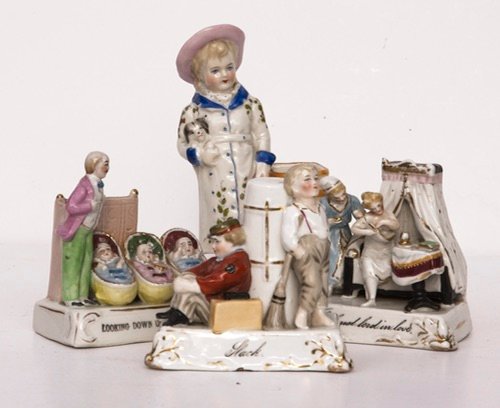
Collection of late 19th century pottery figurines
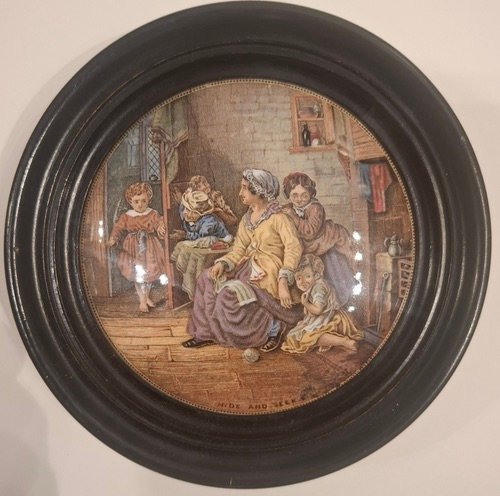
‘Hide and Seek’: A ‘Prattware’ porcelain toothpaste jar lid c. 1860 (nowadays often found, like this one, in a frame)
The same appetite for everyday scenes spread well beyond paper and canvas into other media. Staffordshire potteries decorated jugs, pot lids and plaques with colourful scenes of rural life, sporting pastimes and popular heroes, the best known being Prattware, while from the 1840s the cheerful Staffordshire flatback figures began to appear on cottage mantelpieces all over the country, bringing art of a sort within reach of almost every household. My two little gouaches are a perfect example of this new, more accessible art. In the end, the story of these two small pictures is the story of a bigger change: over the 19th century, art took a step down from the great house and was welcomed into the parlours of ordinary families. A pair of forgotten ‘Victorian prints’ in a box of junk was a reminder to me that art should not be exclusive and that it really doesn’t have to cost a fortune to have merit.